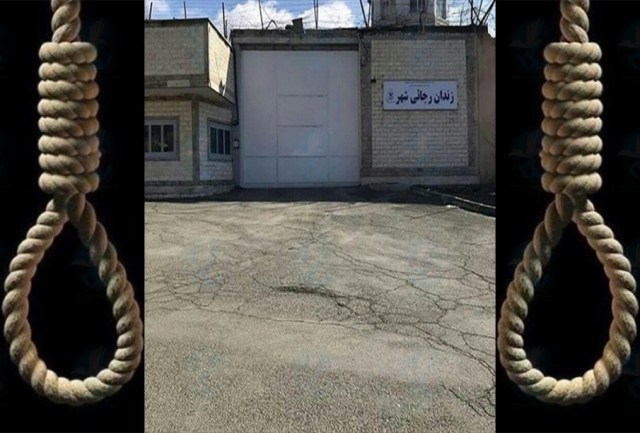
The death sentence of Amir Gravand, a prisoner accused of premeditated murder and incarcerated in ward 10, Corridor 31 of Raja’i Shahr Prison in Karaj was carried out after being approved by the Supreme Court.
According to Human Rights in Iran quoted from Rokna (News Agency), on the morning of Wednesday, June 19th 2020, Amir Gravand, a prisoner accused of premeditated murder, incarcerated in ward 10, Corridor 31 of Raja’i Shahr Prison in Karaj, arrested 14 years ago after the murder of one of his friends named Mehr Ali, after the investigation procedures sentenced to retaliation (Qisas), was executed in this prison.
The prisoner is identified by Human Rights in Iran as Amir Gravand, 38 years old, from Borujerd (W Iran), imprisoned in ward 10, Corridor 31 of Raja’i Shahr Prison in Karaj.
On May, 4, 2006, the dead body of a young man was found in the elevator pit of the Tehran International Exhibition and conducted a criminal case by the investigation team. In the initial investigation the victim was identified Mehr Ali, born in 1966 who was one of the workers of the exhibition. Forensic examinations showed the cause of death was the strike of a hard object to the head.
Following the investigation, the murderer, Amir Gravand, a colleague of Mehr Ali was arrested. Amir was last seen with the victim and his old feud with the victim motivated the criminal team to detain him. Amir had left the scene after committing the murder and when the officers went to his city to arrest him they found out that he had escaped and this point strengthened the hypothesis that he had committed the murder.
The investigation to the arrest of the fugitive defendant continued until in 2007, the persecution of the criminal team ended and the young defendant was arrested. During the investigations, he stated: “Both me and Mehr Ali were working in International Exhibition, but I was looking for another job for more income. Eventually I decided to do drugs trafficking, but I needed money to do so. I went to Mehr Ali to get money from him, but when I submitted my request, he objected and I was very angry with him.”
The young defendant continued: “A few days before the incident, I bought a 30-centimetre iron bar and I hid it on the seventh floor of the parking lot of the International Exhibition center, where we were resting. On the day of the accident Mehr Ali and I were alone in our resort, and I raised the issue of the money again, but when he said no, I was very angry to hear that, and I picked up the iron rod I had already bought. Mehr Ali was drinking tea when I attacked him. After the death of Mehr Ali, I took his 300,000 Tomans in cash and threw his body into the elevator pit and threw his belongings in a corner of the street”.
With the confession of Amir Gravand to this murder and the reconstruction of the murder scene, the case was referred to the 1st Criminal Court of Tehran province and after the hearing, the death sentence of this prisoner charged with murder was issued. Following the announcement of the protest and the referral of the case to the Supreme Court, the death sentence was upheld. Some time ago, Amir Gravand was taken to be hanged in Raja’i Shahr Prison, but he was able to get deadline from victim’s parents. But after the deadline expired a few days ago, Amir went to the gallows again and this time at the request of the victim’s family, he was executed 14 years after the murder.
According to the annual report by Amnesty International in 2019, the Iranian government executed at least 251 people. At least 4 of those executed were under the age of 18 at the time of crime. However due to the lack of transparency of the authorities, it is difficult to find out the actual number of executions in this country and it may be much higher than the announced figures.
Considering the International Instrument of Human Rights and also the Article 5 in Universal Declaration of Human Rights, no one should be treated in a manner that causes their degradation and humiliation.
On February 18, 2020, Amnesty International released a report describing human rights abuses in Iran, in which issued a report on the issuance and enforcement of death sentences: “International human rights law allows acts involving same-sex sexual intercourse with reciprocal consent and extramarital sex; muharebeh (enmity against God), spreading corruption on earth, insulting Mohammed the prophet and fighting against Islamic State are crime titles punishment of which is execution and hanging while there is no vague definition for them, yet.”
 Hoghoghebashar.iran